

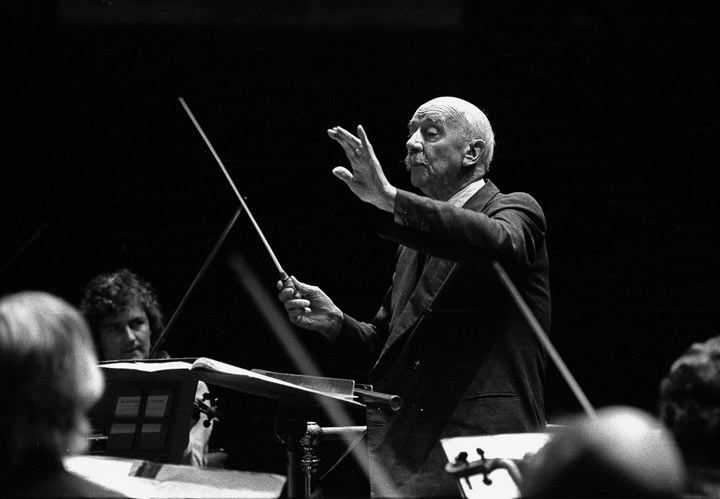
The conductor has hypnotized the orchestra.
His remarkably long baton, over two feet in length, is electric, possessing a strange power that mesmerizes all observers. With tremendous economy of gesture, the maestro moves his lightning rod of a baton with only his wrist, gently displaying a tender L shape. Strangely, he appears, for a brief moment, to be asleep. But suddenly, his entire arm moves back in preparation for a musical exclamation, and instantly, he becomes the mighty god of thunder, bringing down his magnificent hammer upon the orchestra. The musicians respond with vigor, as though illuminating the sky with a towering flash of light.
The conductor is Sir Adrian Boult (1889-1983).
The most remarkable thing about the master’s technique is how little he does. One of his students, Vernon Handley, described seeing Boult conduct the first time as being “like remembering how to conduct, rather than discovering.”
“In other words, every single thing he did–and he didn’t do much–but everything he did immediately produced results.”
Handley highlights Sir Boult’s economy of gesture in the above video. “It was obvious to me that if he wanted a little more weight from the cellos, he wouldn’t thrust a hand out at the cellos with mock vibrato, he would just incline his head towards them for six inches, and out came more sound. In other words, every single thing he did–and he didn’t do much–but everything he did immediately produced results.”
The BBC conductor realized what escapes many a young communicator–if everything is loud, nothing is. His approach may be summarized as meaningful simplicity. By remaining relatively subdued, he claimed a rare power: Every movement he did make was conspicuous, clear, and expressive.
Boult’s no-frills technique is instructive, but not just for aspirant conductors. Conducting is, at its core, communication. Nonverbal communication, yes, but communication just the same.
Can Sir Adrian’s minimalistic approach be applied to other forms of communication as well? Certainly. Consider what is more impactful–a busy website, or a simple one?
Sir Winston Churchill mastered this skill in its oratory form. Beginning a phrase, he would pause, meander a bit, roll the words around in his mouth, savor them, release them… Understanding how significant this delivery was, Churchill would practice endlessly, in the mirror, making notes on his script until the very last moment, so that when he finally delivered his oration, any emphasis, every word, every gesture, had meaning.
This is not the easy method. Young speakers, writers and communicators at large understandably tend towards wordiness and unfocused, feverish energy. This writer is a major culprit. As articulated by the great scientist Blaise Pascal, “If I had more time, I would have written a shorter letter.” But the minimalistic economy of effort exemplified by so many masters should be recognized as a worthy virtue to strive for, instead of being passed over as boring or outdated.
It is worth the effort to avoid being, what Sir Boult described as, “one of the sweaty ones.”
 All the Feels